Friday, November 29, 2013

Chushoku


Lunch out is still usually a source of aggravation for me.  

First, there are the hours.  Many restaurants and cafes are open only for dinner.  You may see activity inside, but they are really just preparing for the dinner hours.  Those that are open for lunch typically have extremely limited hours: 11A - 2P.  A late lunch is pretty much out of the question.  Oftentimes you can only order the two or three items from the fixed "lunch set".  The rest of the multi-paged menu is available only after 2P and should thus be considered merely titillating diversions.

I get frustrated with myself because nine-times-out-of-ten I end up in a Western-style cafe because I know I can navigate the menu.  When you are hungry your primal, not cerebral instincts take over.  I will walk for hours looking for that perfect dining combination: friendly/inviting, cool or interesting design/ambiance, not too touristy, not too fancy, not too Japanese (language, not cuisine).  This usually adds up to Western.

I wish I could read a Japanese menu.  Even if I can sound out the Hiragana, I still don't know what I'm reading.  Think about the subtle, almost poetic, descriptions of food on an English menu.  You never see: beef and noodles.  It will read more like: lightly seared grass-fed Texas sirloin strips over tagliatelle in a crème fraîche sauce.  Nowhere in that description do you see the words beef or noodles.  So translate that into Japanese, throw in some Kanji characters….you see the trouble.

Sometimes I pick a proper Japanese restaurant and sit down knowing full well I won't be able to read the menu, there will be no pictures, and probably no English-speaking waiters.  This is simultaneously an act of defiance and punishment.  Basically I am saying to myself: Robert, you can do this, you f*%#ing idiot.

Maybe I ask the server (in Japanese) what he or she recommends.  Or.  Maybe I select something because it is printed in red, instead of black ink (hmm, must be a special).  Or.  If those methods fail, maybe I order by price.  The Robert Wallace Empirical System for ordering food in a foreign country.

It hasn't happened often, but occasionally I am reprimanded for approaching my meal in the wrong manner.  Sometimes it is a polite upturned hand gesturing how I should be doing things.  Sometimes it is put more strongly, "No, no" (in English).

A large Japanese beer is the recommended beverage when using the RWES.  Alcohol goes a long way to relieving dining stress.


Tuesday, November 26, 2013

Sentō-gosho (仙洞御所)


Sentō-gosho (Sentō Imperial Palace) was built for retired emperors in 1630, sort of an old folks home for royalty.  It burned down and was rebuilt several times and then more or less abandoned when the imperial court split for Tokyo in 1868.  Only two of the original structures remain, but the vast garden is magnificent.

It is not as meditative as some of the temple gardens, but it was designed for an emperor in his golden years to stroll and admire, not for a buddhist monk to contemplate.  Apparently it still hosts foreign dignitaries, which would account for the high security - tours are by reservation only and a valid passport must be presented.  There was also the Japanese equivalent of the secret service trailing our group to make sure no one wandered off.


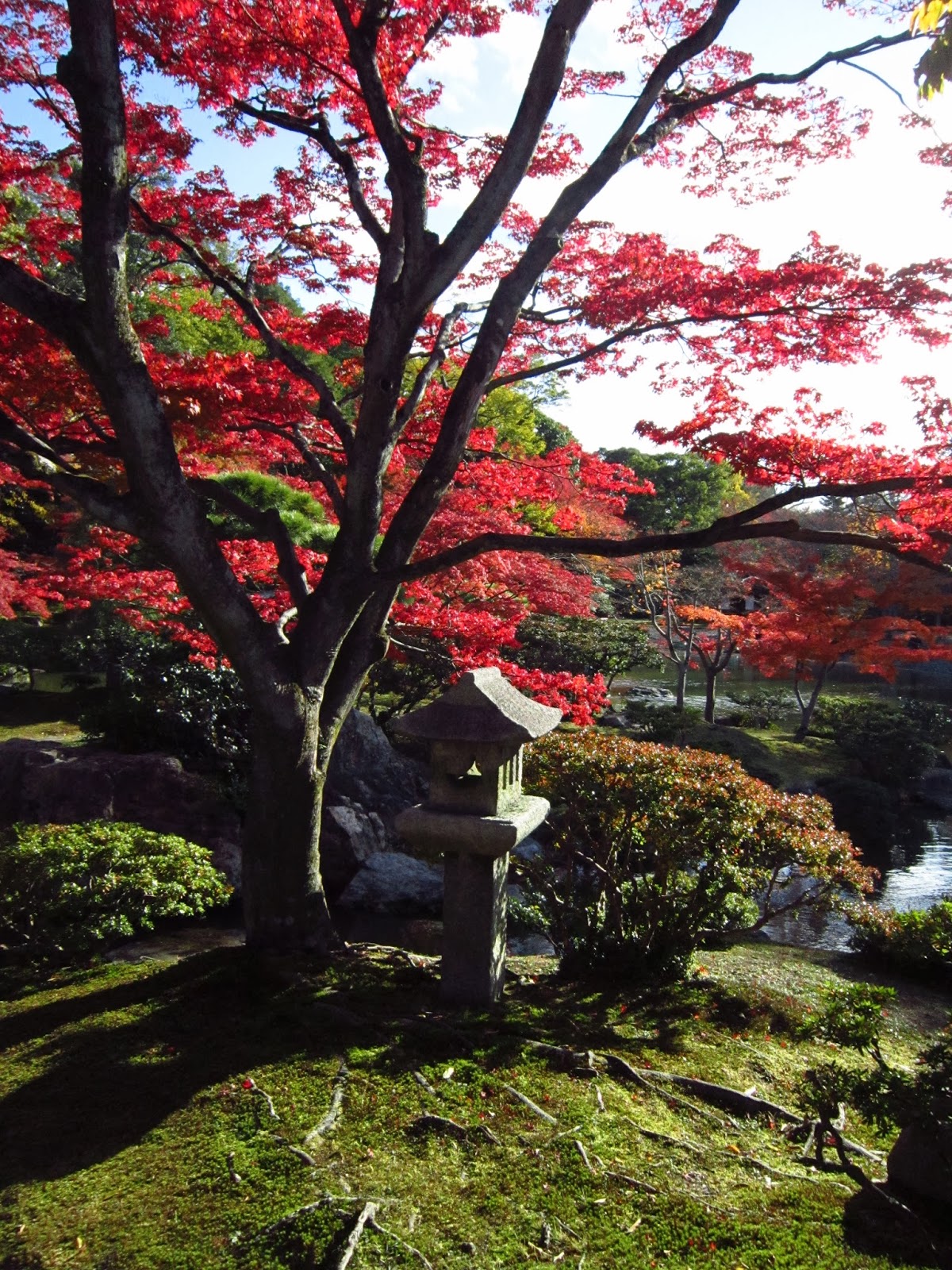
I was not really prepared for the intense autumn hues I saw once inside the garden.  The trees all seem to be at the peak of their color, and the cool breeze was pulling a lot of the leaves down.  In another week or two perhaps most of them will be on the gravel paths or in the ponds.

The tour was conducted entirely in Japanese so those, like myself, who couldn't understand trailed behind taking unobstructed photos.  As the tour pressed on, the shutterbugs lingered to get the best shots, cameras clicking away like paparazzi trying to capture the Beckhams leaving their favorite restaurant in Hollywood.  I found myself strangely pressured to take more photos than I normally do because the others around me with their big, expensive cameras were shooting like mad.  It bordered on competitive sport, with the anglo-gaijin, of course, being the more aggressive photographers in the group of stragglers.  At one point I actually heard one guy say, "Oh, this is the money shot", which couldn't be a more vulgar way to describe such natural beauty.  I decided to rejoin the main tour group after that.


Saturday, November 23, 2013

I went for a walk and...


You may be thinking these photos are manipulated or enhanced.  Uh-unh.  This is Kyoto in all its autumnal glory.

I decided to revisit the Amagase Forest along the banks of the Uji River.  This is almost my backyard, one stop from Obaku on the train.  I had been here in September shortly after I arrived when it still felt like summer.  It was beautiful then, a warm green beauty.  I was hoping for, but not expecting this kind of rich color.

After crossing the Amagase Suspension Bridge, I happened upon a trail leading into the forest of Shirakawa.  I heard a waterfall and saw a mysterious path and headed in.  I can't quite describe what it was like to leave the main road and enter this almost otherworldly environment, dense, lush, alive.  Suddenly there was no noise except for the rushing water of a brook and the air passing my eardrum.  The temperature dropped as the sun was almost blotted out by the thick canopy of trees.  I was completely alone.

There was something eerie and at the same time thrilling about it.  It was like stepping through a portal to another planet or dimension in time.  The call of the loon was co-opted by Hollywood long ago as a background sound for spooky forests.  This migratory aquatic bird likes the forests around Kyoto; I've heard it on more than one occasion.  It too was part of the soundtrack as I walked along the narrow leaf-covered path damp with rain.

The deeper I went into the forest the more I felt I had left the world in a real metaphysical sense.  It's one thing to wander a city without knowing where you're going.  It is quite another to do the same in a forest.  But something compelled me to keep going.  If I was going to end up in China or heaven or Detroit, I wanted to go.  It's always funny when you reach that no-turning-back point.  "Okay, if I turn back now…"  It's more funny when you don't know if that point is midway to your destination or if you've only just begun your journey, or indeed if you even have a destination.

The path twisted along the bank of the creek, climbed the hillside, crossed over tributary streams, passed around fallen trees cum bridges.  Eventually I came to daylight.  An exit.  And I was in another world.  The trail ended in the countryside somewhere.  There were farms and the air smelt of fresh vegetables and hay.  Where the hell am I?  I wandered down a little lane and passed through what appeared to be a sōmon, the wooden gate at the entrance of a temple.  I arrived at an intersection.  I looked one way, then the other.  I had no idea which way to go, no idea if either direction would take me back to Uji.  I decided to re-enter the magic forest and travel back the way I'd come.

It was dusk when I arrived back at the Uji River.  The old-fashioned street lamps were just coming on and their reflection trembled in the water of the river.  I had to smile.  Where am I indeed.


The traveler versus the tourist

I've never been fond of the word tourist.  For me it conjures images of overweight Americans in shorts, big, white, Seinfeld-style sneakers and fanny-packs, eating in the local McDonalds.  I prefer the term traveler.  This word has romance and adventure.  A traveler is someone more deeply committed to the journey.  It is someone that injects themselves into the bloodstream of another nation-state, its traditions, its routines, from the extraordinary to the mundane, and loses themselves there.  Traveling really is an exchange where a piece of the traveler is left in a country, and that gap is filled with something taken away from that land.  The tourist simply brings themselves and their habits to a new place, seeks out the familiar and returns to their homeland unchanged.

I realized that after more than two months in Japan I am neither traveler nor tourist.  I live here.  And if I am successful in changing my visa status I will continue to live here.  The difference between my sojourn in Kyoto and your average tourist is not the length of stay, it is the responsibilities that come with residency, even a three-month stay like mine.  A tourist is most likely staying in a hotel.  They do not have to make the bed in the morning.  They do not have to make coffee and breakfast.  They do not have to do the dishes or laundry.  They do not have to go to the market to buy onions and milk, udon and eggs.  They have no housekeeping responsibilities.  They are not studying Japanese.  They are not looking for a job.  They are not researching visas and Japanese immigration.  They are not creating a new body of work in an upstairs atelier and hustling their art at galleries.  They are not planning exhibitions for the New Year.  They are not applying to foundations for grants.  They are not going to acupuncture for a sore neck.  They are not getting their hair cut.  They might be meeting new people, but there probably aren't any subsequent render-vous with these new acquaintances.

I enjoy all of this (well, maybe not Japanese immigration law) because it is part of the experience.  It means I'm here, living in Japan not just visiting.  I like knowing which streets connect, and when the last train is (23:58).  I like having a local cafe where they know me, if not by name, at least by face.  I like saying "Ohayo gozaimas" to the neighbors in the morning instead of a hotel staff.   It's cool.  

It's cool living in Japan.


Thursday, November 21, 2013

Kamogawa Haiku


Sitting in the river
Not getting wet
The world drifts by quietly

Tuesday, November 19, 2013

Errant paths


Rule no. 1
Do not set out to find something on an empty stomach.  Your patience will be greatly diminished, and your frustration significantly amplified.

Rule no. 2
Know the distance between your point of origin and your destination.  Failure to obtain this information in advance may result in extreme fatigue.

There was a gallery on my list of important/interesting Kyoto art spaces that I had yet to visit - Foil.  Strangely, it was at the top of that list, and almost 8 weeks had slipped by without attempting to locate it.

I began my journey to Foil at Karasuma-Shijo.  I headed in a north-west direction, passing Nijo Castle.  I was fairly certain the gallery lay in the neighborhood bound by Sanjo to the south, Oike to the north, Horikawa to the east and Senbon to the west.  I had an address; I even had cross streets.  The only problem (it's really always the same problem) is that the streets in my notebook were written by me in Romaji and the street signs are of course written in Kanji.  I wandered up and down the streets believing not only that I was in the right area, but that the gallery would simply show itself, like a pervert in a trench coat flashing his privates.  Well, I was not in the right neighborhood.  That was never going to happen.  I inquired at another gallery I chanced on, "Foil Gallery wa doko desu ka?" 

They showed me on a map.  It was far.  I didn't want to trek back to the subway, and I'm still a little uncertain about bus routes so I walked.  And walked.  The gallery was off Imadegawa Dori between Horikawa and Senbon.  I had the east-west part of the grid correct, but the north-south coordinates were way off.  It was about 3 miles I walked from point A to point B, not including the errant search.  That is a lot of burnt shoe leather.

So what I discovered from this navigational error is this:  I still don't know where I am or where I am going in Kyoto.  Omit the word Kyoto and that statement may also apply to my life.

Monday, November 18, 2013

生け花 (Ikebana)


Flower arrangement (Ikebana), as with most everything in Japan it seems, is a disciplined art form.  And like so many art forms here its roots (no pun intended) can be traced back hundreds of years to a buddhist priest.  In Kyoto, of course.  

FTD this is not.  Stuffing a vase full of posies is not ikebana.  In fact, there are actually very few flowers in ikebana.  There are plenty of branches and twigs and stems and leaves and roots, but flowers…no.  Styles have changed and evolved over the centuries and different schools have come into and fallen out of fashion, but what defines ikebana really is elegant minimalist compositions.

I was given a ticket by Ito-san to an ikebana exhibition at the Takashimaya department store.  To be honest, I had no idea it was a floral design exhibition.  I don't remember her explaining anything.  She simply gave me the ticket and told me it was at Takashimaya.  So I went.  And I was rather impressed.  I've never seen anything like it.  (I've said that a lot since I arrived in Kyoto, haven't I?)

My list of things I'd like to learn more about seems to grow every week I'm here.  I can add ikebana to that list.