Friday, May 19, 2017

Murin-an


The marquee flora in Japan are of course the sakura (cherry) in spring and the momiji (maple) in autumn.  These trees get top billing and their annual shows bring in billions of tourist Yen.  But just as in film, there are supporting actors in a garden, plants that make the stars shine.  These players are not flamboyant and the niwa (garden) paparazzi, so focused on the celebrity trees, will just as likely give them a miss.  

In April, just as the last cherry blossom has been whisked away by a persuasive breeze, there is what is called shinryoku (fresh green of April).  This refers to the incredibly vibrant greens of the new spring leaves on plants and trees.


Murin-an villa in the Sakyo ward of eastern Kyoto was built in 1896 by Aritomo Yamagata, an Elder Statesman and advisor to the emperor during the Meiji (1868 - 1912) and Taisho (1912 - 1926) Eras.  Three structures - a wood sukiya-zukuri-style house, a red brick Western-style house and a Yabunouchi-style tea house - sit on more than 3,000 square meters of land.  It is a gorgeous garden that occupies the vast majority of this large property.


Yamagata's aesthetic differed slightly from most.  His vision for the villa garden was something more natural, something that resembled the countryside with wildflowers and a meandering stream.  He wanted the garden to blend seamlessly into the Higashiyama Mountains in the distance.  The concept of musakui-no-sakui was paramount.  This means the garden should appear as if Mother Nature alone created the landscape, even if it is in reality the meticulous work of many gardeners.


I went to Murin-an for the "Fresh Greenery Illumination" which the villa hosts every year at the end of April/beginning of May.  A recent and unfortunate trend at temple illuminations is projection mapping.  There was none of that here.  The lighting was soft and subtle highlighting the brilliant greens of the garden.  Visitors were invited to sit in the washitsu of the main building and simply gaze into the garden as night fell over it.

As the sun faded and the natural light changed, so too did the garden.  There was a slow shift in depth.  Some plants and trees emerged and others receded into the darkness.  Silhouettes grew stronger.

Of course there were no electric lights in the garden when Yamagata had it built.  Apparently he was fond of the moonlight playing over the stream and meadow.  That vista must have been even more serene.


Monday, May 1, 2017

Ohara Festival of Spring (春の大原女まつり)


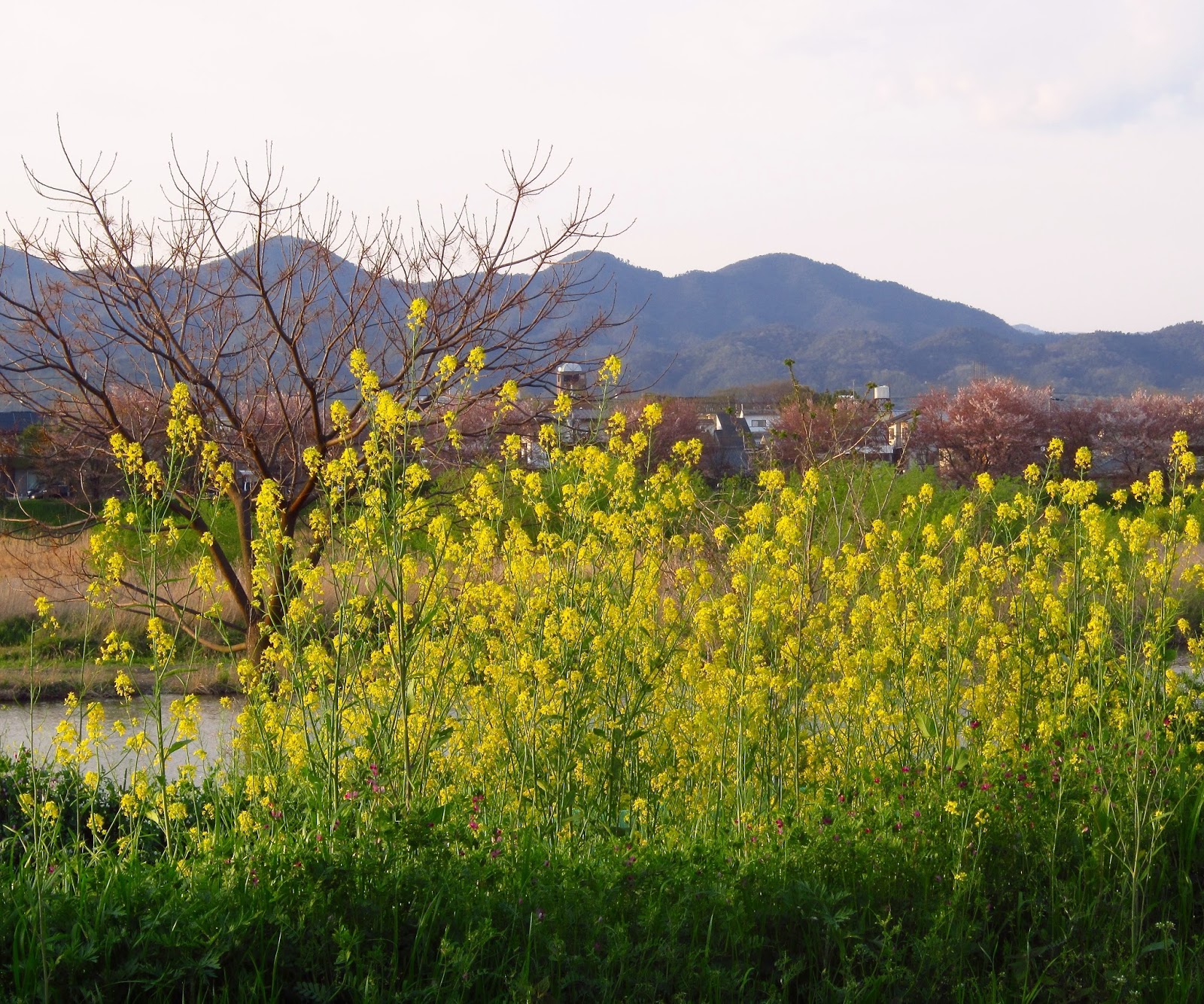
Spring in Ohara - wildflowers color the hills yellow and only incidentally purple, the trees are dressed smartly in shinryoku green, the sky is stretched bright and wide, the narrow Kusao River that cuts through the little farms is a lazy soundtrack.

Painted into the foreground of this pastoral tableau are some 50 or 60 women and girls wearing traditional aizome (indigo-dyed) kimono and white tenugui (kerchief), the same as their peasant ancestors wore in centuries past.  The colors are ultra-vivid - blue, red, orange, white - the layered patterns and textures striking.  These were work clothes of the Kamakura Era (1192 -1333), humble garments, purely functional.  They are a stark contrast to the splendid and rarefied kimonos of the imperial court, or even the geisha of Gion.  Dressed so, the women of Ohara would carry kindling, coal, flowers and various produce into the city on their heads.  


The annual Ohara Festival of Spring (春の大原女まつり) celebrates the season and the women of this rural town in the mountains north of Kyoto.  Women and girls parade along a narrow road from Jakkoin Temple across the Takano River to Sanzenin Temple.  Generations of Ohara residents, grandparents down to toddlers, step out of their houses to watch it go by.  It is a lovely spectacle.

I have seen other gyoretsu (processions) in Kyoto, impressive, but rather sober events, participants and spectators stone-faced, serious.  Oharame Matsuri is light, cheerful, everyone smiling, greeting each other.  Everybody seems to know everybody.  I find myself smiling too.  It is a contagious joy.

Not even halfway to their destination storm clouds gather and a cold rain begins to fall.  The entire group scurries into a cafe along the route.  Light cotton tenugui and  waraji (straw rope sandals) are no match for a spring thundershower.

I take shelter under the eaves of a nearby building and wait with a few others for the storm to pass.  The matsuri paparazzi, moments earlier climbing over each other to get photos of the beautiful Oharame (Ohara women), abandon the project completely and race for their cars with their big, expensive cameras.  I wait and I wait, listening to the rhythm of the rain, watching the sky, looking for some blue through the gray.  45-minutes later the rain stops and the sun returns, but the parade does not resume.  I suppose the momentum is lost, the continuity broken.  A cruel joke by Mother Nature, the proverbial rain on the parade.

I am disappointed, but at the same time grateful to have witnessed the marvelous start of this Oharame Matsuri.  Next year...there's always next year.


Thursday, April 6, 2017

Core Kyoto


When I returned to Kyoto in the autumn of 2014 after a 6-month sojourn in Los Angeles it was my friend Taka who helped me secure an apartment.  His aunt, Kazuyo Kawamoto, owned an apartment building.  He mentioned her vocation was something to do with a singular, traditional Japanese craft.

Shortly after settling in I scheduled an informal rendez-vous with Kawamoto-san in her atelier, two floors below my apartment.  I wanted to see what she does.  She pulled out some fabric with incredibly detailed beading on it.  On closer inspection I realized it wasn't beading at all.  It was hundreds and hundreds of tiny knots.  Then she demonstrated the technique, an extraordinarily precise, rhythmic manipulation of thread and fabric.  The concentration and patience required for this work was mind-blowing.

Kawamoto-san doesn't speak any English and at the time I spoke very little Japanese.  I could appreciate the beauty of her work, and the tremendous dedication, but I didn't quite understand how this gorgeous fabric was used.  What was the end product?

NHK (Nippon Hōsō Kyōkai, Japan's national public broadcasting network) hosts a weekly program called "Core Kyoto".  It is a consistently engaging show highlighting the people and culture of contemporary Kyoto with deep roots in the city's history.

Last month there was an episode about Kyo-kanoko shibori - Japanese tie-dye.  This is not your crude, rainbow whorl seen on countless Grateful Dead T-shirts.  This is a painstaking, time-consuming art form dating back to the 7th Century.  A bolt of fabric (36 X 1300cm) for a single kimono requires the labor of half a dozen specialized artisans and can take more than a year to complete.

This is what my landlord does for a living.  She is one of only a handful of people in Japan that still plies this craft.  She has been recognized by the Emperor for her skill.  I've seen the medal of honor.

It's funny.  I see Kawamoto-san almost everyday, walking her Shiba-inu, watering her plants.  We chit-chat about the weather.  I’ve had dinner with her and the family.  She always makes me smile.  She is "core Kyoto" and I'm lucky to know her.

Sunday, March 26, 2017

ぐでたま (Gudetama)

"tired"

Japan loves its manga (comics) and anime (animation).  It will create characters from and for anything.  While in the States our cartoon characters tend to be of the biped and quadruped variety (humans, dogs, cats, mice), the Japanese will anthropomorphize any number of inanimate objects or otherwise non-sentient beings.

Gudetama is a cartoon egg with a deep malaise and a predisposition toward existential thought.  He is the ultimate slacker, completely lacking in motivation (gude = lethargic, tama, from tamago = egg).  He is not interested in becoming a chick.  In fact, he'd rather return to his shell than face the day let alone the future.  Mostly what he wants to do is sleep.  His snooze button is always on.

Gudetama was created by artist Nagashima Emi for the kawaii (cute) product giant Sanrio in 2013.  His absurd character profile on the Sanrio website only confirms the inherent laziness of eggs.  His likeness appears on hundreds of Sanrio products, from tote bags and coffee mugs to chopsticks and bento boxes.  He has also appeared in some 500 one-minute animated shorts with a forlorn, squeaky, little voice muttering things like:

"Cold world" (せちがらい) while lying in an egg slicer; and
"What can we do about it?" (スッパリあきらめよう) after being sliced into pieces by said device.

While Gudetama's laziness may run contrary to the industrious national character, his ennui is perhaps not so far removed from Buddhist thought and the concept of transience.  A cute sakura blossom would have been a more obvious embodiment of this melancholia, but the perfect beauty of an egg is also fleeting.  And it is more funny.

何かと大変な世の中だけど (What a tough world it is)

- ぐでたま (Gudetama)


Wednesday, March 15, 2017

A villa in Japan


Where I grew up, outside of Los Angeles, there are myriad residential architectural styles - Spanish Colonial Revival, Bungalow, Tudor Revival, Mid-century Modern, etc.  That is California.  The architecture reflects the free-to-be lifestyle.

Japan is different.  A little less free-to-be.  There is classic minka (traditional residential) architecture including machiya (townhouse), nōka (farmhouses), gyoka (maritime houses) and sanka (mountain houses).  And that is about it.  While there is of course some variation among these building styles they are all quintessentially Japanese.  Following the War bland Western-style architecture was almost unanimously adopted.  Contemporary residential architecture is generally of the humdrum, cookie-cutter variety.

It is rare and surprising to see a house here built in a pre-War American or European style.  South-west of Kyoto, perched in the hills above where the Katsura, the Uji and the Kizu Rivers meet is such a house.  The Oyamazaki Villa is a British-style residence built by wealthy businessman Shotaro Kaga over a 20 year period beginning in 1912.  I can only guess he must have been a bit eccentric to shun convention and design a house like this.  If you block out some of the indigenous flora you would swear you were in the English country.

The villa was rescued from demolition in 1990 by Asahi Brewery and following an extensive renovation was reborn as an art museum complete with a stylish new wing by internationally renowned architect Tadao Ando.  In 2004 it achieved "Tangible Cultural Property" status, which is impressive for a piece of 20th Century Western-style architecture.

There are thousands of little towns across Japan, station stops on a local train that you pass on your way to somewhere else.  They all have some claim to fame - a shrine, a temple.  Some, like Oyamazaki, have the first Japanese whiskey distillery (Yamazaki, est. 1929) and perhaps the only Tudor-style villa in the country that is a historical landmark.


Monday, March 6, 2017

be-kyoto


In the winter of 2007 Junichi Uchiyama and his new wife Mayu Okamoto opened their multipurpose gallery/event space on a quiet street near Doshisha University in the Kamigyo ward of Kyoto.

They chose a wonderfully creative name for the space: be-kyoto.  The Japanese word 美, meaning beauty, is pronounced “bi” the same as the English word “be”.  Playing with meaning and phonetics in two languages the name is a simple affirmation of the existence of this beautiful city, and at the same time it is a gentle nudge to the artist to take on the spirit of Kyoto, become Kyoto.

The building the gallery came to inhabit was also carefully selected.  Rather than a New York-style "white cube" they decided to renovate a 200-year-old machiya (townhouse) in the shadow of Kosho-in Temple.  This decision would unwittingly place them at the heart of the burgeoning historical architecture preservation movement in Kyoto.

Uchiyama-san and Okamoto-san have quietly woven themselves into the cultural fabric of Kyoto over the last 10 years as the hosts of countless exhibitions, performances and workshops.  Yesterday they celebrated that accomplishment with a lovely party.  The international be-kyoto family, young and old, gathered in the washitsu (traditional Japanese room) to sip sake and listen to legendary shamisen musician Gensen Tokuyama.  Floral designer Kuniko Tsuji transformed the gallery into a pre-season hanami (cherry blossom viewing party).

Here's to another 10 years!  Long live be-kyoto!