Monday, September 21, 2015

Ahead of the harvest


10-minute walk to the Katsura River.  There is rural Japan.  Japan from 100 years ago.  And I imagine, Japan 100 years from now.  Farming is labor and the coming and going seasons.  That's it.  The knowledge, part instinct, part technique passed down from generation to generation.  This is mom-and-pop agriculture.  By hand.  It is brilliant colors, contrasts.  Beginnings and ends, life and death.  A wonderful mélange of organization and chaos.  Neat rows and impossible tangles.  The farmer is a master of reusing and repurposing materials.  Nothing is wasted.  Small fires burn what can't be used over.  The air is pleasantly scented with this smoke.  It lingers in the fading afternoon light.

Wednesday, September 9, 2015

Musing


I woke with a real sense of possibility.  It was the morning sun spilling over the mountain touching the drops of night rain still clinging to everything.  It was an incredible light.  I was filled with joy.  For five or ten minutes it felt like everything would work out.

One can't hope for anything more.  Those minutes are a treasure.

Friday, August 28, 2015

Atsui desu, ne


It has been so hot for so long, without pause, I wonder if it will ever be cool again.  I've even forgotten the sensation of feeling cold.  Winter is a distant memory, and seems like a dream or maybe a voyage to another country.  I looked at my wool scarves in the closet and couldn't ever imagine needing those here in Kyoto.

It is a heat that makes you a little dizzy, a heat that makes you feel slightly sick.  It touches not only your body, but your mind.  It controls your every action, like a disease.  You can think of nothing else but the temperature.  It dominates conversation: atsui desu ne (it's hot, isn't it).  You hear this phrase over and over and over.  It is a reflex, like blinking.

The world even sounds different in the summer heat, a low, dull, mumble.  The science fiction soundtrack (circa 1955) provided by the hundreds of cicada in the trees makes you think the apocalypse is nigh.  You are sure the Earth is on a collision course with the sun.  It is only a matter of time before things begin to spontaneously combust, the city around you engulfed in flames.

There is always a note in the information pamphlets you get at temples and shrines about the structures burning down.  They are never specific as to the cause of the fires.  I'm sure now it is spontaneous combustion caused by summer heat.  I believe this may be the real reason the emperor moved the capital to Tokyo after more than a thousand years.  The royal family just couldn't take the summers anymore; they wanted a home in a slightly cooler locale.

Sweating while engaged in vigorous physical activity - sport, labor, etc. - is normal.  This heat is such that even perfectly static positions like sleeping somehow produce perspiration.  Eating, sitting, standing, reading, talking are all sweaty activities in Kyoto during the summer.

I now understand the semi-obsessive placement of vending machines dispensing beverages around the city.  It is not so much competition among beverage giants like Asahi and Suntory; it is something more noble - an attempt to save the population from fatalities like sun stroke and heat exhaustion.  The vending machines placed every 50 meters or so are aligned with the distance a human can walk in temperatures near 40°C (104°F) before needing to slake one's thirst.

I said something similar about the Kyoto winter last year: 17 summers in New York could not prepare me for summer in Kyoto.

Sunday, August 2, 2015

Notes from Kamigamo Tedukuriichi


An early rising with the cicada.  The heat and sunshine already pouring into my apartment.  The Sunday train platform is quiet.  The walk from Kitaoji station along the Kamo River is pleasant, the sound and smell of the river somehow makes me feel cooler.

I arrive at Kamigamojinja sometime after 8:00.  The temple grounds are already buzzing with vendors setting up shop.  I realize immediately I am a rank amateur among serious professionals.  Giant, mylar picnic tents, sandwich board signs, easels, tables with table cloths, director chairs, multi-tiered shelving, bust-forms, racks, hangers, mirrors.  I unroll my tatami mat on the gravel with the large black ants and place my moku hanga T-shirts in six neat stacks.  Open and ready for business in 5 minutes.  This is the Zen approach to business.  Exactly and only what you need, nothing superfluous.

I am happy to see my neighbor shares the same minimal aesthetic.  He sells musical toys made from found and recycled materials.  I become slightly less self-conscious.

I am grateful for the clouds that periodically block the blazing sun.  It is my only respite.  One must suffer silently, I suppose.  My other neighbor, a jewelry maker, graciously offers me the shade of her tent.  I fear I may ruin her business if the passerby see a gaijin, so I place my chair at the back of her space.

One hour and 35 minutes pass before anyone stops to look at my T-shirts.  The seeds of doubt have been planted.  I am reminded of the pop-up gallery I had in Red Hook.  The hours and hours of doing nothing.  Only here there are hundreds of people expressing their indifference to my creations.  In Red Hook simply no one turned up, so the insult was less bruising.

I am glad for the ¥1,200 folding chair I bought.

The horrible "Engrish" mall T-shirts parading by are salt in the wound.

On this sweltering day mostly people just want something to drink, or maybe a fan or hat or tenugui to mop their sweaty brow.

The musical toy maker sits stoic on his little stool waving his fan like a Buddhist monk doing zazen.

I busy myself by shaking the dust from my T-shirts and sprinkling the gravel with water.

I study the people passing, try to pick out the ones who might be interested in a limited edition moku hanga T-shirt: a young rock-n-roller, a stylish mother, a hip dandy.  But no, but no.  Everyone walks by without a glance.  I think I could have a sign that reads "free T-shirts" and they would still pass by.

Hot, tired, dirty and disappointed, I close shop at 2:00.

Sunday, July 19, 2015

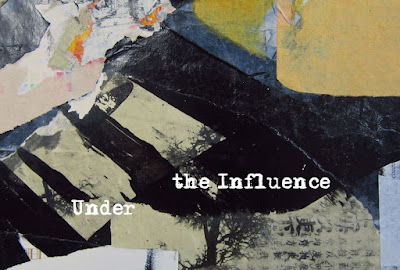
Under the Influence

 Foil Gallery


           the Influence
Under

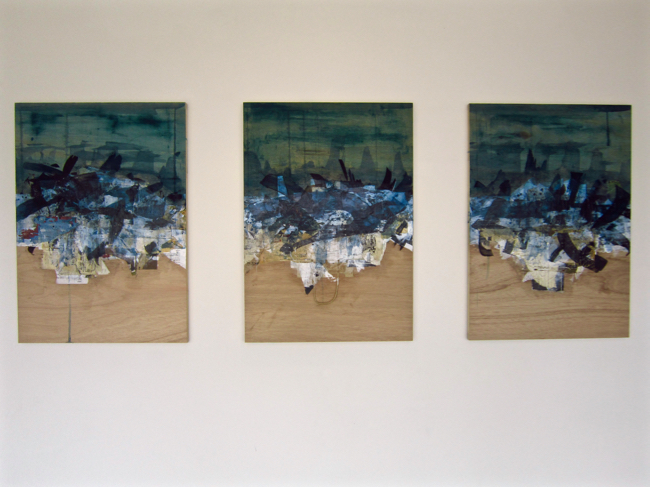
paintings and the collected ephemera of life
by Robert Wallace

201581 – 816  |  August 1 – 16, 2015
オープニング・パーティー82() 17:00-19:00  |  Opening: Sunday, August 2 17:00-19:00


かつてファッションデザイナーのポール•スミス氏は、”インスピレーションはどこにでもある”と言いました。
まさにその通りで、通勤通学での道のり、電車や車での移動中、近所のカフェやショッピングマーケットなど日常生活のあらゆる場面でインスピレーションを受ける事ができます。
これらの大小様々な影響を無視せず認識して行く事は、流れの速い21世紀を生きて行くにあたってとても大切な要素なのではないでしょうか。
私のアートは、この”日常の陽炎”(その瞬間に出会う日常の出来事)が原動力になり、またそれらは実際に私の絵画の原料となりました。新聞、地図、レシート、手紙、ショッピング袋、名刺、小説の1ぺージ、映画のチケットなど、私のアートは日常生活の中で出て来る廃棄物によって構築されています。まさに私のアートの中に、私の生き方の本質を見出す事ができるでしょう。

このエキシビションUnder the Influenceでは、私たちの身の回りにある一見ランダムで何の変哲のないものを使用し、それを全く違う角度から新しいものとして見ていただきたく、また私のアートに触れた方々がそれぞれの日常の陽炎を考慮していただけるキッカケになれば、と願っております。


The English fashion designer Paul Smith once said “you can find inspiration in everything.”  Indeed the world around us not only inspires us, but shapes who we are as individuals.  Our environment, from our home to our school to our office, from the train we take to the road we drive, from the café where we dine to the market where we shop all have an influence on us.  Every detail of our daily life affects and informs us.  One can’t really navigate life in the 21st Century successfully without acknowledging these indiscriminate influences.

My artwork springs from this “ephemera quotidian”.  It is literally the source material for my paintings.  They are built from and upon the daily detritus of my life: the morning newspaper, a street map, a market receipt, a letter, a shopping bag, a business card, a page from a novel, a movie ticket.  This material provides the texture of my life and at the same time the texture of my paintings.

Under the Influence is my attempt to show how all these seemingly random and unrelated things collect around us, penetrate our subconscious and resurface as something else.  For me, these are the influences large and small that shape my paintings.  This exhibition is an invitation for the viewer to consider their own personal daily ephemera and what influence it has upon them.

 Foil Gallery