Wednesday, February 8, 2017

Ume (梅)


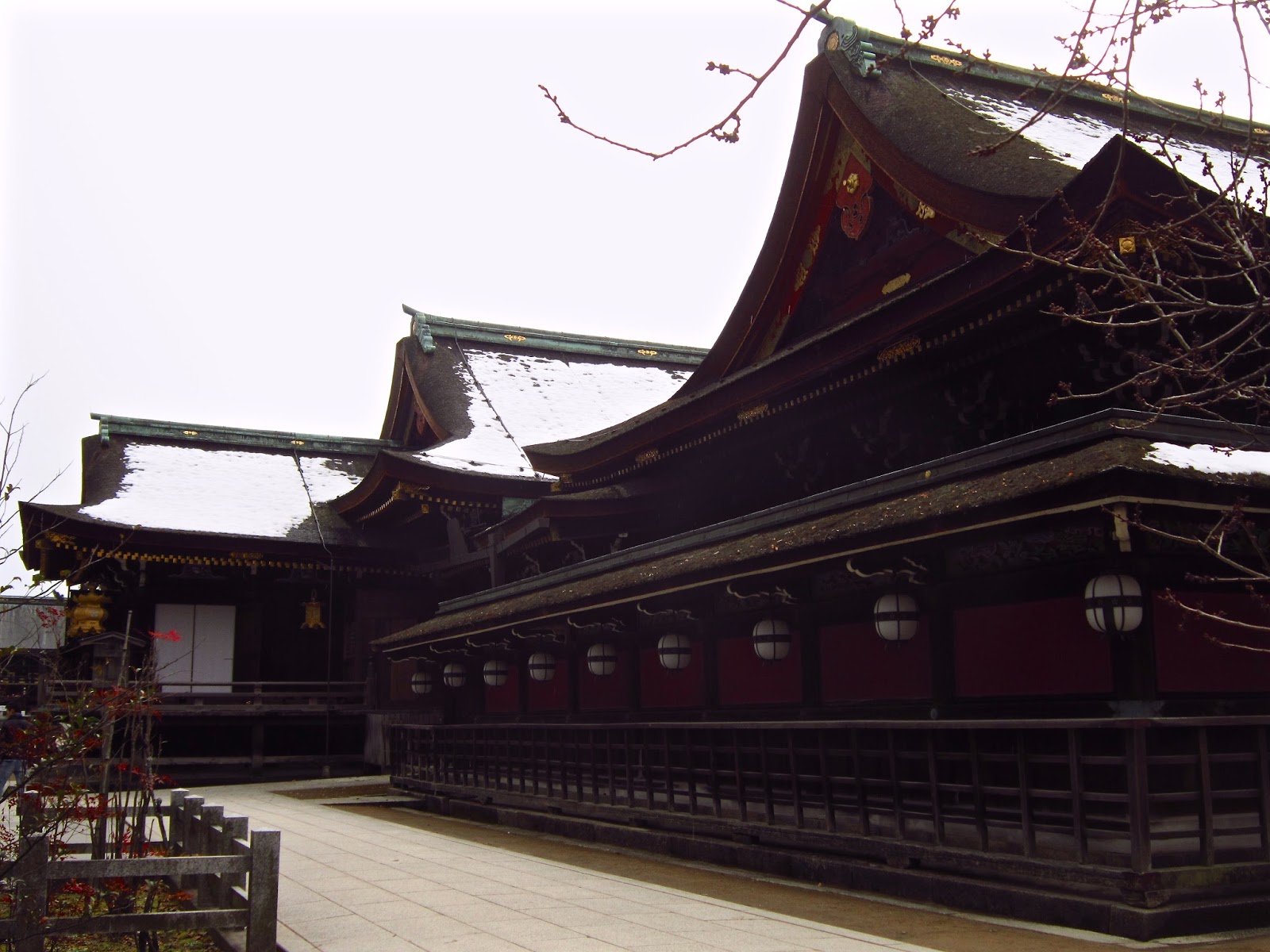
I set out from Ryoanji with no particular destination.  A dérive.  I left the main road and let the side streets and architecture guide me.  In Kyoto it is not long before you stumble onto a temple or shrine.  I crossed over the Tenjin River and suddenly Kitano Tenmangu appeared.  I had been to this shrine once before a few years earlier, but because I was approaching it from a different direction I didn't recognize it.

I was surprised to see the temple crowded with people.  Even more surprising were the hundreds of ume (plum) trees bursting with the first blossoms of the season.  I had seen a lone ume blossom a few days earlier on a farm in Katsura.  Despite the frigid January temperatures this flower had somehow forced itself into the world, a single white blossom on a tree black with winter rain and snow.

Kitano Tenmangu is famous for its ume.  It was the favorite tree of Sugawara Michizane, a Heian period (794–1185) scholar, poet and politician to whom the shrine is dedicated.  Ume Matsuri (Plum Blossom Festival) has been celebrated here every year on February 25th for more than 900 years.  Apparently, before sakura (cherry blossom) came into fashion, ume was the favored spring flower of the Japanese nobility.  This tree also holds a special place in Japanese folklore as a guardian against evil spirits.  It is traditionally planted in the north-east corner of a garden, the direction from which evil is believed to come.  And unlike the sakura, the ume tree bears fruit, which when pickled is a Japanese specialty.

In early February when the sky is a sharp gray these little pink and white flowers arrive punctuating the stark winter landscape.  While they don't have the same celebrity and industry built around them as the sakura, they are still beloved by the Japanese as a harbinger of spring.


In the U.S. a scruffy rodent called the groundhog is the messenger of spring.  Its appearance on February 2nd after a long winter slumber roughly marks the halfway point of winter.  In Japan it is the considerably more charming ume blossom that announces the coming season.


Exposed


自分の作品を見せる事は自身をさらけ出すということ.  それはより多くの、皮膚よりももっと深い何かである.  単なる裸とはまた違うもの.  それはX線検査により近い何か.  組織、骨、器官…  世の中の人々に自分の心臓を預けて検査してもらうような感覚.  その間の数分、あるいは数時間、数日、または数週間はそれなしで機能しなければならない.  それは容易なことではなく、苦しんだり、弱くなってしまったり、壊れてしまうかもしれない.  でもそれが終わる時、もし幸運に恵まれたなら.  心が以前よりも少しだけ大きく、強くなって戻ってくるかもしれない.

ギャラリーbe京都にて開催された私の個展、Checklistにお越し下さり、個展を応援して頂いた皆様、誠に有難うございました。

又、ギャラリーbe京都の内山 純一様、岡元 麻有様に心より感謝申し上げます。


Anytime you show your artwork you are exposing yourself.  It’s something more, something deeper than skin.  It is not mere nakedness.  It is something closer to an x-ray.  Tissue, bones, organs.  It is your heart you have invited the public to examine.  For some minutes or hours, days or weeks, you have to function without it.  This is not easy.  You may suffer, grow weak, break down.  When it’s over, if you’re lucky, your heart will be returned to you a little bit bigger, a little bit stronger.

Thanks to everyone who came to the gallery or showed their support for my exhibition, “Checklist” at be-kyoto gallery in Kyoto.

A very special thanks to Junichi Uchiyama and Mayu Okamoto of be-kyoto gallery.

Wednesday, February 1, 2017

Checklist: exhibition views


Filmed over three years in Japan this short film accompanies my exhibition "Checklist" at be-kyoto gallery in Kyoto January 28 - February 2, 2017.

Wednesday, January 18, 2017

Checklist


Robert Wallace
Checklist
January 28 – February 2, 2017

ロバート・ワァレスによる個展「Checklist」のご案内
2017128-22

Opening reception: Sunday, January 29, 17:00 – 19:00

The Checklist came to me in an unexpected way in New York back in 1997.  My friend, the artist Daniel Joseph gave me a painting.  I asked him to sign it.  He turned it over and started writing.  3 or 4 minutes later he handed it back to me.  Along with his name he had written a checklist.  It was not a list of things to do, or things to remember, but random, disjointed thoughts.

The Checklist was the brainchild of Dan’s friend, artist Brian Moran.  I had seen scraps of paper with these odd, sort of free form poems around Dan’s Van Brunt St. apartment/studio in Red Hook.  Brian invited me to participate.  He outlined the "rules", which were just two: 1) the checklist must be 33 in length; 2) the last item in the list must be the word “degrees”.  Brian had been reading about Freemasonry.  33 is a significant number for this secretive international order, being the highest “degree” or level one can rise to.  Of course it has a special meaning in many cultures and religions, including Buddhism.  According to the Lotus Sutra, Kannon Bodhisattva has 33 transformations to assist in human salvation.  I was never quite sure if Brian was making a joke or if he too believed in the power of this particular number.

For me the Checklist is ephemera, little scraps of life that float into and out of ones mind.  It comes to you in the same way thoughts or other bits of text do: fragmented, broken, incomplete, disjointed, unrelated.  It can literally spring from any source.  Wherever there are words there is material for a Checklist.  One word.  A sentence.  A paragraph. 

A Checklist need not make sense or have a logical chronology.  It need not have a rhythm or flow.  It need not be thematic.  Consider the incalculable number of thoughts that flood ones mind in any given instant.  It is impossible to process it all, to listen to everything.  These itemized mental, written, verbal and aural snippets are what strike us, what make us stop for a second before we return to our train of thought, resume our activities.

The structure of a Checklist is quite simple.  It can be assembled in minutes, a spontaneous, stream-of-consciousness transcription.  Or they can evolve, as mine usually do, over weeks and months.  When one re-reads a Checklist built over time it becomes a sort of catalogue or record of ones fragmented life.  For me, these are the most successful/interesting, because they are so completely random and less prone to manipulation by daily emotion or fleeting mood.  They are the most free and ultimately poetic.

In the end a Checklist is perhaps nothing more than a vain and futile attempt to capture in writing the tiny details of ones life as they speed by too quickly and in too great a volume to ever grasp.  I endeavored with this exhibition to express visually, in paint and collage, what a Checklist is.  Embedded in each painting are Checklists written since I arrived in Japan almost three years ago.  Sometimes the words are visible and sometimes they are not; sometimes they float on the surface, sometimes they are buried deep within the painting, just as thoughts rise and sink in our head, and the vast amount of information we process is retained or discarded.  The paintings are united by materials and color palette, but lack a cohesive style, much the same way Checklists are all made up of words, but have no relation to each other.  It is the complete randomness of the mind and our lives I am inviting the viewer to consider.


Sunday, January 15, 2017

Kyoto snow

The snow in Kyoto is light and playful.  It puts smiles on faces.  It's not aggressive; it doesn't howl or bite.  It doesn't try to disrupt transportation or stop commerce.  It doesn't overstay its welcome or leave a mess.  Like confectioners' sugar from a patissier's shaker it floats down retexturing the city, softening its hard edges, highlighting its dark planes.  It almost seems choreographed, curated.


Friday, December 9, 2016

Made in Japan


I wanted to get some geta (traditional Japanese wooden sandals) as a gift for someone.  Being December these are at least 6 months out of season.  There is a shop on Teramachi-dori called Yamanaka (established 1909) that specializes in this unique footwear.  I'd passed it dozens of times before.  I was hoping it wasn't a seasonal shop, or that they would now be selling snow boots.

It was open and a full range of geta and zori (traditional Japanese sandal for women worn with kimonos) were on display.  A kindly old woman wearing a work apron greeted me and after explaining what I wanted in Japanese she wasted no time showing me a variety of styles.

The geta in Yamanaka are something like a made-to-measure suit.  They are not completely bespoke (custom-made), but they are not ready-to-wear either, that is, a single manufacturer's standard.  Geta are made from a single block of wood called a dai.  One can select the shape and style of the dai here.  The hanao, or thongs, are also customizable with a variety of cotton fabric patterns to choose from.  

After I selected the dai and the hanao pattern the proprietress told me it would take about twenty minutes to assemble the geta.  In the 21st Century where it seems everything is instant, it is unusual to wait for anything.  I found this was not an inconvenience, but a pleasure.  It is a joy to watch someone work that really knows his or her craft.  I imagine this woman could probably assemble geta blindfolded.

Sitting on her zabuton (cushion) she worked with a set of well-worn specialized tools.  The hanao was secured to the dai with a hemp cord using a variety of attractive knots - no glue!  The geta were finished with a small Yamanaka logo which she tapped into the heal with a brass stamp.


Monday, December 5, 2016

Maki's Blues

I was listening to "Japanoise" bands like Mono and Boris long before I came to Japan.  Japanese musicians are particularly good at this kind of super sonic, non-vocal, experimental rock, and these groups have a small but global fan-base.  But music sung in Japanese is by and large not exported to the West.  Some of the most popular groups of the last 20 years - artists like Ayumi Yamasaki, AKB48 and Arashi - that have sold more than 30 million records in Japan are completely unknown anywhere else.  While American and British musicians tend to be bent on world domination, Japanese artists seem to be content with an audience that doesn't reach beyond their shores.

I have made feeble attempts to discover Japanese music since I arrived almost three years ago.  I like the traditional music played on the shamisen and flute, but finding recorded music in a record store is near impossible because of my lack of knowledge and my poor Japanese.  From time to time I happen upon interesting contemporary musicians performing here in Kyoto, but these occasions are few and far between.

Last month my friend Aki in New York (better known as the musician/DJ AKA SUGA) released her new album "No Label".  On one of the tracks she references a Japanese singer Maki Asakawa.  I looked her up.  I was fairly blown away.

Miss Asakawa began her career as a cabaret singer in Tokyo in the mid 1960s, frequently performing at the social clubs on American military bases.  However, unlike other female singers of the time she shunned the exotic eroticized image of the Japanese woman and dressed in ankle-length black dresses, wore her hair long with bangs and sang blues and jazz covers in Japanese.  Perpetual cigarette in hand and a passion for black American music as well as French literature and film, Asakawa was the ultimate cool for the intellectual university crowd of the 1970s.

But it is her voice.  A beautiful, dark, melancholic contralto that is both Japanese and not at all Japanese.  East meets West.  It is sometimes the sorrowful moan of a solo singer in an odori (traditional dance), and sometimes the sultry croon of an American lounge singer.  It is a voice that somehow transcends language altogether.  A sublime musical instrument, rather than a mundane oral mechanism for transmitting information.

I've found the blues in Japan.  To it and dig!

Maki Asakawa "Blue Spirit Blues"