Sunday, March 26, 2017

ぐでたま (Gudetama)

"tired"

Japan loves its manga (comics) and anime (animation).  It will create characters from and for anything.  While in the States our cartoon characters tend to be of the biped and quadruped variety (humans, dogs, cats, mice), the Japanese will anthropomorphize any number of inanimate objects or otherwise non-sentient beings.

Gudetama is a cartoon egg with a deep malaise and a predisposition toward existential thought.  He is the ultimate slacker, completely lacking in motivation (gude = lethargic, tama, from tamago = egg).  He is not interested in becoming a chick.  In fact, he'd rather return to his shell than face the day let alone the future.  Mostly what he wants to do is sleep.  His snooze button is always on.

Gudetama was created by artist Nagashima Emi for the kawaii (cute) product giant Sanrio in 2013.  His absurd character profile on the Sanrio website only confirms the inherent laziness of eggs.  His likeness appears on hundreds of Sanrio products, from tote bags and coffee mugs to chopsticks and bento boxes.  He has also appeared in some 500 one-minute animated shorts with a forlorn, squeaky, little voice muttering things like:

"Cold world" (せちがらい) while lying in an egg slicer; and
"What can we do about it?" (スッパリあきらめよう) after being sliced into pieces by said device.

While Gudetama's laziness may run contrary to the industrious national character, his ennui is perhaps not so far removed from Buddhist thought and the concept of transience.  A cute sakura blossom would have been a more obvious embodiment of this melancholia, but the perfect beauty of an egg is also fleeting.  And it is more funny.

何かと大変な世の中だけど (What a tough world it is)

- ぐでたま (Gudetama)


Wednesday, March 15, 2017

A villa in Japan


Where I grew up, outside of Los Angeles, there are myriad residential architectural styles - Spanish Colonial Revival, Bungalow, Tudor Revival, Mid-century Modern, etc.  That is California.  The architecture reflects the free-to-be lifestyle.

Japan is different.  A little less free-to-be.  There is classic minka (traditional residential) architecture including machiya (townhouse), nōka (farmhouses), gyoka (maritime houses) and sanka (mountain houses).  And that is about it.  While there is of course some variation among these building styles they are all quintessentially Japanese.  Following the War bland Western-style architecture was almost unanimously adopted.  Contemporary residential architecture is generally of the humdrum, cookie-cutter variety.

It is rare and surprising to see a house here built in a pre-War American or European style.  South-west of Kyoto, perched in the hills above where the Katsura, the Uji and the Kizu Rivers meet is such a house.  The Oyamazaki Villa is a British-style residence built by wealthy businessman Shotaro Kaga over a 20 year period beginning in 1912.  I can only guess he must have been a bit eccentric to shun convention and design a house like this.  If you block out some of the indigenous flora you would swear you were in the English country.

The villa was rescued from demolition in 1990 by Asahi Brewery and following an extensive renovation was reborn as an art museum complete with a stylish new wing by internationally renowned architect Tadao Ando.  In 2004 it achieved "Tangible Cultural Property" status, which is impressive for a piece of 20th Century Western-style architecture.

There are thousands of little towns across Japan, station stops on a local train that you pass on your way to somewhere else.  They all have some claim to fame - a shrine, a temple.  Some, like Oyamazaki, have the first Japanese whiskey distillery (Yamazaki, est. 1929) and perhaps the only Tudor-style villa in the country that is a historical landmark.


Monday, March 6, 2017

be-kyoto


In the winter of 2007 Junichi Uchiyama and his new wife Mayu Okamoto opened their multipurpose gallery/event space on a quiet street near Doshisha University in the Kamigyo ward of Kyoto.

They chose a wonderfully creative name for the space: be-kyoto.  The Japanese word 美, meaning beauty, is pronounced “bi” the same as the English word “be”.  Playing with meaning and phonetics in two languages the name is a simple affirmation of the existence of this beautiful city, and at the same time it is a gentle nudge to the artist to take on the spirit of Kyoto, become Kyoto.

The building the gallery came to inhabit was also carefully selected.  Rather than a New York-style "white cube" they decided to renovate a 200-year-old machiya (townhouse) in the shadow of Kosho-in Temple.  This decision would unwittingly place them at the heart of the burgeoning historical architecture preservation movement in Kyoto.

Uchiyama-san and Okamoto-san have quietly woven themselves into the cultural fabric of Kyoto over the last 10 years as the hosts of countless exhibitions, performances and workshops.  Yesterday they celebrated that accomplishment with a lovely party.  The international be-kyoto family, young and old, gathered in the washitsu (traditional Japanese room) to sip sake and listen to legendary shamisen musician Gensen Tokuyama.  Floral designer Kuniko Tsuji transformed the gallery into a pre-season hanami (cherry blossom viewing party).

Here's to another 10 years!  Long live be-kyoto!


Sunday, February 12, 2017

Ohara


I first visited Ohara last spring (2016) when my parents were visiting.  It is just an hour north of Kyoto Station.  It is technically still part of Kyoto, lying within the city limits.  But it is a world away in spirit.  Perhaps it is the altitude (291m / 955 ft).  Life in the mountains always feels different - in any country.  The big sky, hemmed in only by tree and rock.  The space, the quiet.  Civilization dominated by Nature, rather than the other way round.  You can breathe in the mountains.  Everything is clear, bright, alive.

Jikko-in

When you sit in a temple you are basically sitting outdoors.  When the shoji screens are open it is only the roof separating you from the elements.  In spring and summer, even autumn, this is no problem.  In winter it is a different story.

You are drawn to the beauty of the snow-covered garden.  The rocks and trees, black brushstrokes against the immaculate white, like a sumi-e painting.  You sit down on the tatami as you would any other time of year.  But within minutes you feel the bite of the cold air.  Your best winter socks cannot compete with 0°C  (32°F).  Your toes begin to numb.  Your breath lingers in the air like temple incense.  Your nose and ears are the next to succumb to the frigid temperature.  A gentle breeze blows the falling snow inside and you watch it melt first on the engawa (veranda) and then the tatami.  You enter a sort of trance as your blood slows and your internal furnace starts to falter.

It is a battle of the will.  A seasoned Buddhist monk might have the mental and spiritual power to survive a winter afternoon meditating in this environment.  I am no monk.

Wednesday, February 8, 2017

Ume (梅)


I set out from Ryoanji with no particular destination.  A dérive.  I left the main road and let the side streets and architecture guide me.  In Kyoto it is not long before you stumble onto a temple or shrine.  I crossed over the Tenjin River and suddenly Kitano Tenmangu appeared.  I had been to this shrine once before a few years earlier, but because I was approaching it from a different direction I didn't recognize it.

I was surprised to see the temple crowded with people.  Even more surprising were the hundreds of ume (plum) trees bursting with the first blossoms of the season.  I had seen a lone ume blossom a few days earlier on a farm in Katsura.  Despite the frigid January temperatures this flower had somehow forced itself into the world, a single white blossom on a tree black with winter rain and snow.

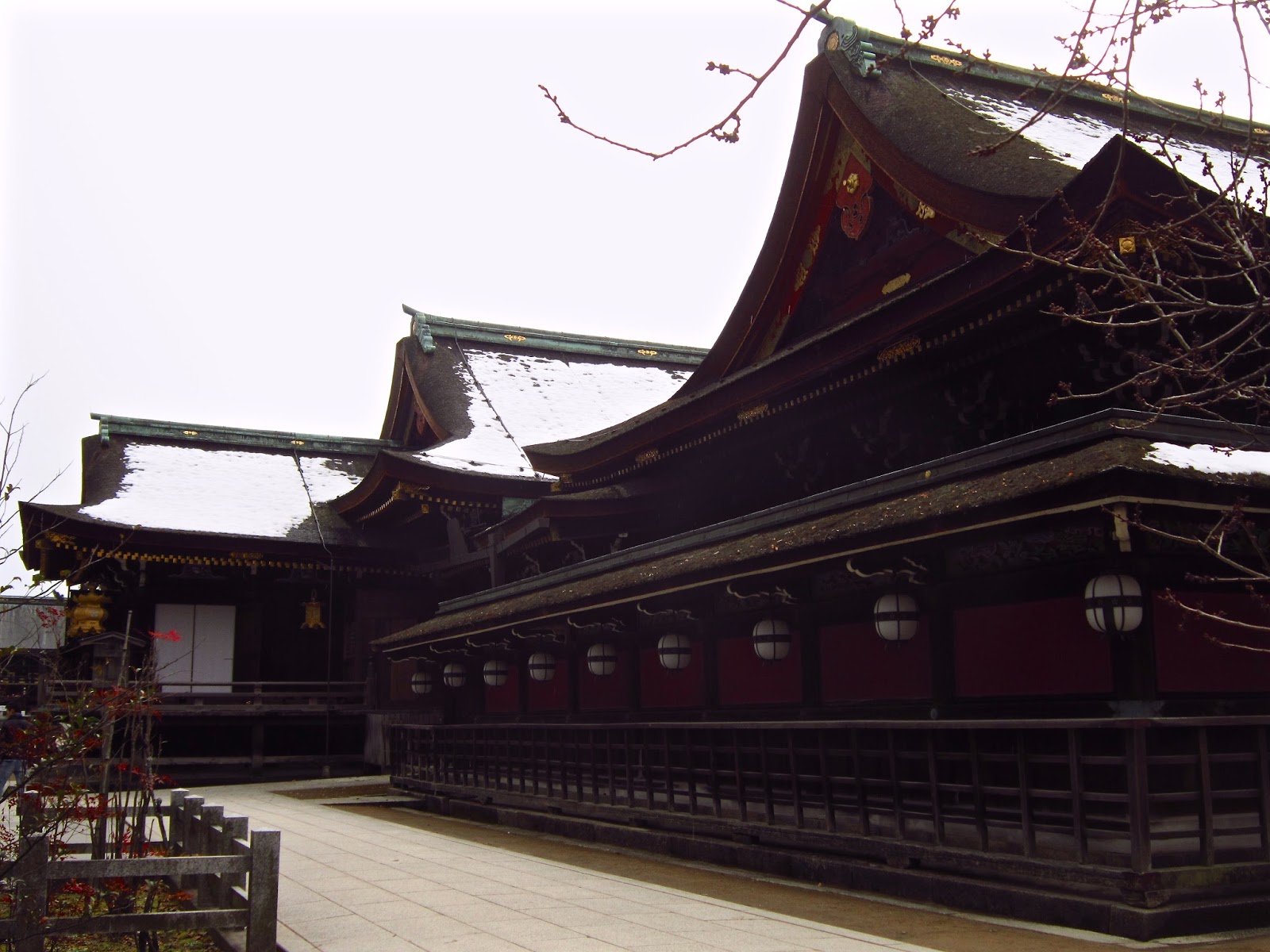
Kitano Tenmangu is famous for its ume.  It was the favorite tree of Sugawara Michizane, a Heian period (794–1185) scholar, poet and politician to whom the shrine is dedicated.  Ume Matsuri (Plum Blossom Festival) has been celebrated here every year on February 25th for more than 900 years.  Apparently, before sakura (cherry blossom) came into fashion, ume was the favored spring flower of the Japanese nobility.  This tree also holds a special place in Japanese folklore as a guardian against evil spirits.  It is traditionally planted in the north-east corner of a garden, the direction from which evil is believed to come.  And unlike the sakura, the ume tree bears fruit, which when pickled is a Japanese specialty.

In early February when the sky is a sharp gray these little pink and white flowers arrive punctuating the stark winter landscape.  While they don't have the same celebrity and industry built around them as the sakura, they are still beloved by the Japanese as a harbinger of spring.


In the U.S. a scruffy rodent called the groundhog is the messenger of spring.  Its appearance on February 2nd after a long winter slumber roughly marks the halfway point of winter.  In Japan it is the considerably more charming ume blossom that announces the coming season.


Exposed


自分の作品を見せる事は自身をさらけ出すということ.  それはより多くの、皮膚よりももっと深い何かである.  単なる裸とはまた違うもの.  それはX線検査により近い何か.  組織、骨、器官…  世の中の人々に自分の心臓を預けて検査してもらうような感覚.  その間の数分、あるいは数時間、数日、または数週間はそれなしで機能しなければならない.  それは容易なことではなく、苦しんだり、弱くなってしまったり、壊れてしまうかもしれない.  でもそれが終わる時、もし幸運に恵まれたなら.  心が以前よりも少しだけ大きく、強くなって戻ってくるかもしれない.

ギャラリーbe京都にて開催された私の個展、Checklistにお越し下さり、個展を応援して頂いた皆様、誠に有難うございました。

又、ギャラリーbe京都の内山 純一様、岡元 麻有様に心より感謝申し上げます。


Anytime you show your artwork you are exposing yourself.  It’s something more, something deeper than skin.  It is not mere nakedness.  It is something closer to an x-ray.  Tissue, bones, organs.  It is your heart you have invited the public to examine.  For some minutes or hours, days or weeks, you have to function without it.  This is not easy.  You may suffer, grow weak, break down.  When it’s over, if you’re lucky, your heart will be returned to you a little bit bigger, a little bit stronger.

Thanks to everyone who came to the gallery or showed their support for my exhibition, “Checklist” at be-kyoto gallery in Kyoto.

A very special thanks to Junichi Uchiyama and Mayu Okamoto of be-kyoto gallery.

Wednesday, February 1, 2017

Checklist: exhibition views


Filmed over three years in Japan this short film accompanies my exhibition "Checklist" at be-kyoto gallery in Kyoto January 28 - February 2, 2017.